
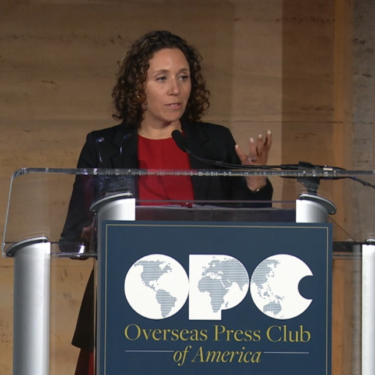
During her keynote address at the Overseas Press Club Awards on Monday night in New York, AP Executive Editor Julie Pace stressed the urgent need for original, firsthand reporting in today’s volatile information landscape.
“News doesn’t reveal itself from a distance,” she said. “It has to be witnessed.”
Pace’s remarks come as The Associated Press was recognized with two Overseas Press Club Awards and two citations for reporting that exposed the global reach of surveillance technology and documented the human toll of war in Gaza.
In particular, Pace pointed to the work of Mariam Dagga, a Palestinian journalist whose photojournalism documenting hunger in Gaza was honored with OPC’s Robert Capa Award. She was among five journalists killed in an Israeli strike on Aug. 25.
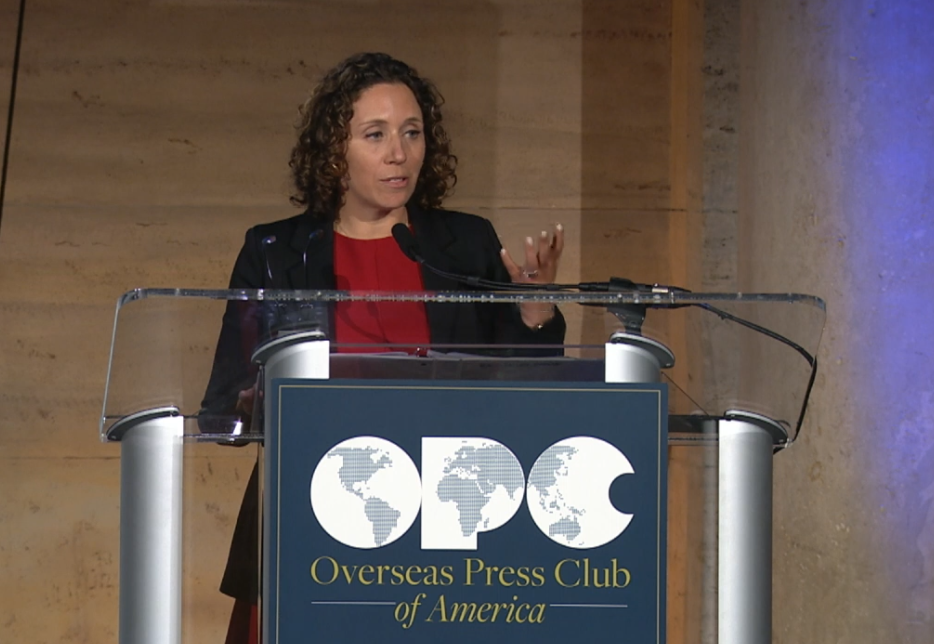
“When we talk about the importance of being on the ground — of eyewitness journalism — we’re not talking about an abstract idea. We’re talking about people like Mariam, and what it takes to do this work well,” Pace said.
“We’re talking about the difference between saying something happened and understanding what it means. Between asking questions and giving an opinion. That difference is often a journalist in the room, on the street, at the border— asking one more question, noticing what doesn’t quite add up, staying long enough for the real story to emerge. That kind of reporting takes time and resources. Often, it takes risk. And right now, that work is getting harder.”
Pace also emphasized the importance of standing up for the right of the press and the public to speak freely without government retaliation or control – even when it’s inconvenient or uncomfortable.
“At a moment when people are already questioning who and what to trust, compromising our principles doesn’t strengthen or help preserve journalism — it weakens it. It doesn’t make the public trust us more – it leads people to view us with more suspicion or disdain,” she said.
“And we can’t afford to lose more of the public’s support – not at a time when there are so many ways for people to get information. Not at a time when information is being summarized and translated instantly by AI — when text, and increasingly images, are being generated that look, at a glance, like real journalism.
“We have to show people why what we do is different. Why everything we’ve been talking about tonight – our values, our independence, our eyewitness journalism – matters.”
In the era of AI, Pace said firsthand journalism remains essential.
“The truth doesn’t arrive on its own. Someone has to be there to witness it.”

Related articles