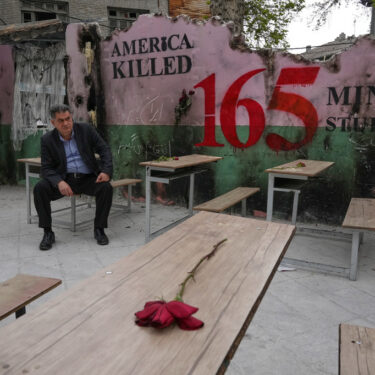
On the first day of the war with Iran, after the United States and Israel launched their strikes, footage emerged of what looked to be a bombed Iranian school, and state media reported the deaths of 150 students. The images were searing, but little information came out about what had happened, from either Washington or Tehran. That is, little did, until Julia Frankel and a team of AP journalists in the U.S. and Middle East revealed the results of their monthslong investigation.
As a reporter in Jerusalem, Frankel was working on AP’s live blog when several of the war’s initial strikes appeared to hit the school in Minab. Over the ensuing weeks, Frankel and others scoured satellite imagery and open-source mapping, interviewed people with deep contacts in Iran and worked Pentagon sources in Washington to try to complete the picture of the strikeand determine who was responsible.
They identified that bombs had struck the school, as well as several buildings in the neighboring compound. Through open-source mapping, they determined that the compound next door was a Revolutionary Guard base and barracks. Their analysis of a state TV video of the missiles falling on the compound showed the munitions appeared to be U.S.-made Tomahawks, which neither Israel nor Iran is known to have. They also found maps released by the Pentagon showing the locations struck in the first 24 hours of the blistering offensive — with a big red dot on Minab.
Collaborating with Beirut-based investigative reporter Sarah El Deeb and Cairo-based reporter Amir Radjy, they also gathered as much testimony and information as they could. Among the details they unearthed were descriptions of how rescuers at the scene found small backpacks, children’s drawings and a tiny arm.
The resulting piece, which included photos and a video explainer, led to a raft of reader emails lauding the reporting.
Judges cited the AP team’s tenacity in delivering a powerful, multifaceted account of the strike.
For their detail-rich package that leveraged AP’s global reach, Julia Frankel, Konstantin Toropin, Mary Clare Jalonick, Lisa Mascaro, Sarah El Deeb, Amir-Hussein Rajdy and Jamey Keaten win this week’s Best of the AP — First Winner.

Related articles