
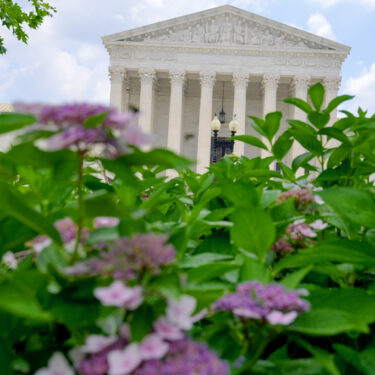
The final days of the U.S. Supreme Court term are unlike any other assignment in American journalism. In less than an hour, the nation’s highest court can reshape immigration, elections, presidential power, civil rights and the limits of government.
AP Supreme Court writers Mark Sherman and Lindsay Whitehurst lapped the field in delivering the news with speed, clarity and depth when the Supreme Court handed down a cascade of landmark rulings, including one on birthright citizenship, on the final days of this term. In minutes, the journalists turned dense legal opinions into easy-to-understand journalism, driving immense engagement with the stories.
For months, Sherman and Whitehurst had prepared for this moment. They interviewed experts, mapped out nearly every possible outcome in the court’s biggest cases, coordinated with reporters and editors across the country and developed plans for every format.
That preparation paid off when the rulings were announced on the last two days of June. AP quickly and accurately moved more than a dozen stories over those two days, including decisions preserving birthright citizenship, expanding presidential firing authority, striking down decades-old campaign finance limits, upholding state bans on transgender athletes participating on girls’ and women’s school sports teams and allowing states to count ballots arriving after Election Day.
The team also covered high-stakes orders, including the court’s refusal to hear President Donald Trump’s appeal in the E. Jean Carroll case. And they delivered takeaways only hours after the coverage of breaking news ended.
Working with AP’s video staff including Jack Auresto and Nathan Ellgren in Washington, Sherman prepared case debriefs on camera in advance, allowing AP to publish polished video analysesalongside the first text stories. AP writers Fatima Hussein and Gary Fields supplied critical courtroom reporting, and Eric Tucker covered the court order on the justices’ annual financial disclosures. AP journalists across the country contributed to a live report capturing reaction and local impact.
Judges were impressed with the impeccable preparatory work, authoritative coverage across formats, and the lightning-fast updates that put AP ahead on every major court decision.
Judges also noted it was the final assignment for Sherman, who retired after two decades covering the beat, capping off a career defined by making one of the nation’s most consequential institutions understandable, accessible and indispensable to readers around the world.
For their comprehensive and exceptional coverage, Sherman and Whitehurst win this week’s Best of the AP — Second Winner.

Related articles