Uncategorized

Seafood From Slaves Shrimp Sheds
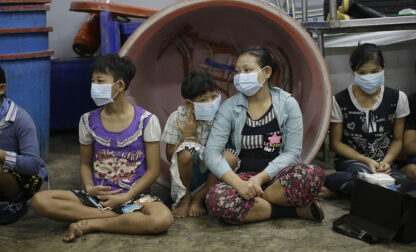
In this Monday, Nov. 9, 2015 photo, children and teenagers sit together to be registered by officials during a raid on a shrimp shed in Samut Sakhon, Thailand. Abuse is common in Samut Sakhon, which attracts workers from some of the world’s poorest countries, mostly from Myanmar. An International Labor Organization report estimated 10,000 migrant children aged 13 to 15 work in the city. Another U.N. agency study found nearly 60 percent of Burmese laborers toiling in its seafood processing industry were victims of forced labor. (AP Photo/Dita Alangkara)

Uncategorized

Global supermarkets selling shrimp peeled by slaves

DEC. 14, 2015

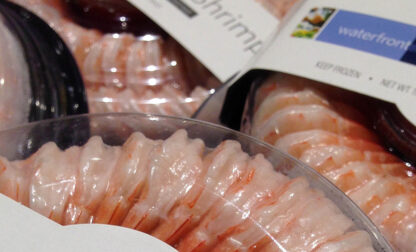
Shrimp products from Thailand packaged under the name
This Monday, Nov. 30, 2015 photo shows shrimp products from Thailand packaged under the name "Waterfront Bistro" at a Safeway grocery store in Phoenix. Despite Thailand's repeated promises to clean up in its $7 billion seafood export industry, little has changed, and shrimp peeled by slaves can still end up in the U.S., Europe and Asia, an Associated Press investigation has found. (AP Photo/Ross D. Franklin)

Uncategorized

AP report on slave-peeled shrimp spurs calls for boycott

DEC. 14, 2015

AP_495861806429
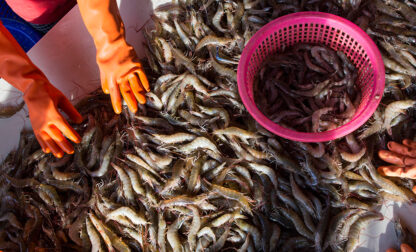
Female workers sort shrimp at a seafood market in Mahachai, Thailand, Sept. 30, 2015. Shrimp is the most-loved seafood in the U.S., with Americans downing 1.3 billion pounds every year, or about 4 pounds per person. Once a luxury reserved for special occasions, it became cheaper when farmers in Asia started growing it in ponds three decades ago. Thailand quickly dominated the market and now sends nearly half of its supply to the U.S. AP PHOTO / GEMUNU AMARASINGHE

Uncategorized

Nestle confirms labor abuse among its Thai seafood suppliers

NOV. 23, 2015

AP152726020805
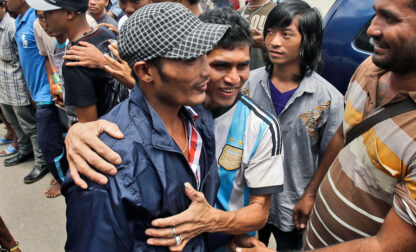
A Burmese fisherman, center, is embraced by a friend as he leaves the port town of Ambon, Maluku province, Indonesia, Sept. 8, 2015. AP PHOTO / ACHMAD IBRAHIM

Uncategorized

More than 2,000 enslaved fishermen rescued in 6 months

SEPT. 17, 2015

Seafood From Slaves Myanmar
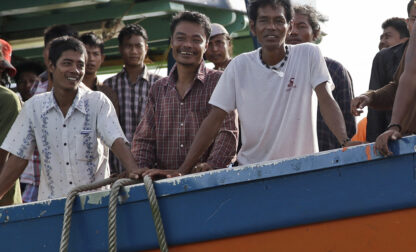
In this Saturday, April 4, 2015 file photo, recently rescued Burmese fishermen smile on their boat upon arrival in Tual, Indonesia. The Burmese men were among hundreds of migrant workers revealed in an Associated Press investigation to have been lured or tricked into leaving their countries and were brought to Indonesia to be forced to catch seafood. The number of enslaved fisherman found on a remote Indonesian island has now reached nearly 550, after a fact-finding team returned on Thursday, April 9, to make sure no one had been left behind in the dramatic rescue nearly a week ago of 330 migrants from Benjina.(AP Photo/Dita Alangkara, File)

Uncategorized

AP investigation prompts new round of slave rescues

JULY 30, 2015

Kaung Htet Wai, Lin Lin
In this July 1, 2015, photo, former Burmese slave fishermen Kaung Htet Wai, left, and Lin Lin, second left, point to a satellite image of a refrigerated cargo ship owned by Silver Sea Fishery Co., in waters off Papua New Guinea, while looking at a laptop screen at their home in Yangon, Myanmar. They said they were among the forced laborers loading slave-caught fish from their trawlers onto the Thai-owned vessel. They say hundreds of fisherman remain trapped at sea. (AP Photo/Gemunu Amarasinghe)

Uncategorized

AP tracks slave boats to Papua New Guinea

JULY 27, 2015

Myint Naing, Khin Than, Mawli Than
In this May 16, 2015, photo, former slave fisherman Myint Naing, left, is embraced by his mother Khin Than, second left, as his sister Mawli Than, right, is overcome with emotion after they were reunited after 22 years in their village in Mon State, Myanmar. Myint, 40, is among hundreds of former slave fishermen who returned to Myanmar following an Associated Press investigation into the use of forced labor in Southeast Asia’s seafood industry. (AP Photo/Gemunu Amarasinghe)

Uncategorized

Myanmar fisherman goes home after 22 years as a slave

JULY 1, 2015

Seafood From Slaves
In this Saturday, Nov. 22, 2014 photo, workers in Benjina, Indonesia, load fish into a cargo ship bound for Thailand. Seafood caught by slaves mixes in with other fish at a number of sites in Thailand, including processing plants. U.S. Customs records show that several of those Thai factories ship to the United States. (AP Photo/Dita Alangkara)

Uncategorized

US lets in Thai fish caught by slaves despite law

APRIL 22, 2015

Indonesia Seafood From Slaves Arrests
FILE - In this April 3, 2015 file photo, rescued Burmese fishermen raise their hands as they are asked who among them wants to go home at the compound of Pusaka Benjina Resources fishing company in Benjina, Aru Islands, Indonesia. Two Indonesians and five Thais were arrested on charges of human trafficking connected with slavery in the seafood industry, Indonesian police said Tuesday, May 12. They were the first suspects taken into custody since the case was revealed by The Associated Press in a report two months ago. The arrests were made Monday and late Friday in the remote island village of Benjina, said Lt. Col. Arie Dharmanto, National Police anti-trafficking unit chief. (AP Photo/Dita Alangkara, File)

Uncategorized

Over 300 slaves rescued from Indonesia island after AP investigation into forced labor

APRIL 4, 2015

Seafood From Slaves
In this Saturday, Nov. 22, 2014 photo, Thai and Burmese fishing boat workers sit behind bars inside a cell at the compound of a fishing company in Benjina, Indonesia. The imprisoned men were considered slaves who might run away. They said they lived on a few bites of rice and curry a day in a space barely big enough to lie down, stuck until the next trawler forces them back to sea. (AP Photo/Dita Alangkara)

Uncategorized

AP Investigation: Slaves may have caught the fish you bought

MARCH 25, 2015

Get in touch

To find out more about how our content and services can help your organization

Contact us
FOLLOW AP

You are now entering the English version

This page is not available in your selected language. You are now viewing the English version.
Continue